Full body suit tattoos have been all over Australian news this year. In September and October 2026, 7News, Yahoo News Australia and New Zealand’s 1News reported on Australians travelling to Bali to be put under general anaesthetic while a team of tattooists works on them at once, finishing a body suit in a single day or two. Doctors have been quick to warn against it. If a body suit is on your mind, here is what Australian medical voices are saying, and how a full body suit is planned and built properly here in Perth.
What doctors are saying about the Bali “pain-free” trend
Speaking to 7News in September, the president of the Australian and New Zealand College of Anaesthetists (ANZCA), Dr Tanya Selak, pointed out that all general anaesthesia carries a degree of risk. She explained that in Australia an anaesthetic must be given in a hospital operating theatre or clinic by a registered specialist anaesthetist, with the staff and equipment needed to resuscitate a patient, and that hygiene and safety standards overseas may not consistently match Australia’s. In late October, Dr Kyle Hoath of the Australian Medical Association told 1News that an anaesthetic “just for convenience” is a dangerous proposition.
Healthy WA, run by the Western Australian Department of Health, already advises against getting tattooed overseas, especially in developing countries, because standards of care differ and there is limited aftercare. It also lists the extra risks of travelling with a healing tattoo, including swimming, sweating, sun, alcohol and showering in water that may not be safe to drink. A whole body healing at once, on holiday, multiplies all of those.
We do not recommend being tattooed under sedation or general anaesthetic. A body suit does not need to be a race.
What is a full body suit?
In the Japanese tradition a body suit usually joins a full back piece with both arm sleeves, the chest and the upper legs, so the whole torso reads as one connected picture. Some people stop at the elbows or above the knees, and others go all the way to the wrists and ankles. Many leave a bare strip down the centre of the chest and stomach, which frames the design and leaves room for open shirts.
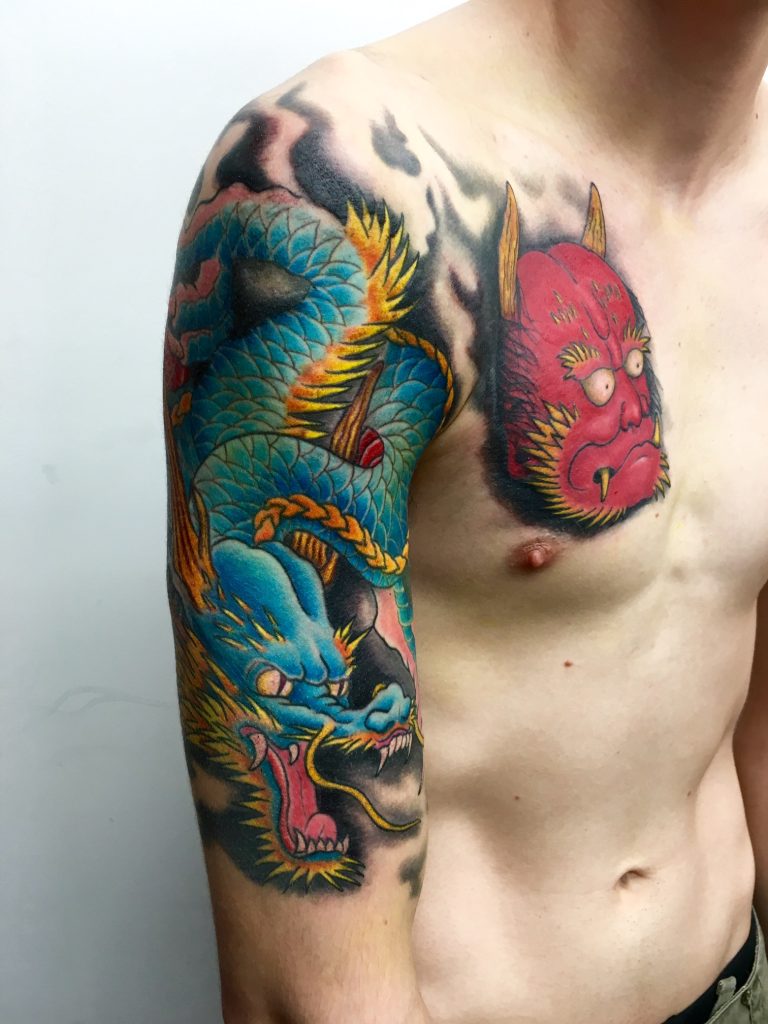
You do not have to plan the whole suit before you start, but you do need to know it is the goal. That way your first piece, often a half sleeve and chest panel like the dragon and hannya work at the top of this page, is placed so everything that follows can connect.
How we build a body suit in stages
- Consultation and overall plan: we talk through the main subjects, such as a dragon, tiger, koi, warriors or folklore figures, and sketch how they will sit across your body.
- Start with one area: usually the back, or a sleeve and chest panel. Outlines go in first, then shading and colour.
- Add the connecting areas: the second sleeve, the other side of the chest, the legs and the hips, joined with water, wind bars, clouds or flowers so it all flows.
- Heal between sessions: each section heals before the next one next to it is worked on. Healthy WA gives two to three weeks as a usual healing time for a tattoo.
- Finish and touch up once everything has settled.
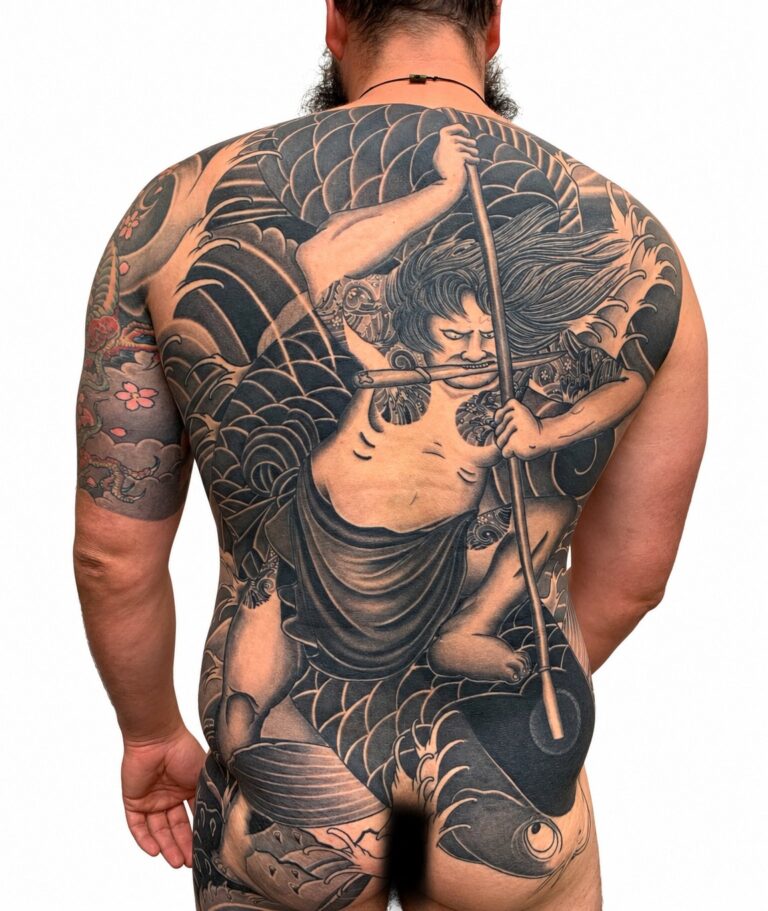
A Kintaro and koi full back piece flowing down over the hips, the core that a body suit is built around.
Working this way takes longer, usually months or years, but you stay in control. You can pace sessions around work and money, see each part heal, and adjust the design as you go. For many people, the journey is part of what makes a body suit meaningful.
Making long sessions easier, safely
Being tattooed is uncomfortable, especially over ribs, stomach and the backs of the knees. Instead of being knocked out, we plan around comfort:
- shorter sessions on the most sensitive areas
- regular breaks during longer sittings
- eating well, staying hydrated and sleeping properly beforehand
- no alcohol for at least 24 hours before and after, which Healthy WA advises because it can increase bleeding and slow healing
Talk to your doctor before using any numbing creams or medicines, and tell us about any health conditions before you book.
Already started a body suit in Bali?
Plenty of people come to us with sections done overseas that do not connect, have healed patchy or stop in odd places. We can often join them up with backgrounds and new main images, darken faded areas, or cover pieces that do not fit the plan. Send clear photos of every area and we will tell you honestly what is possible.
Coming from regional WA or interstate?
Clients travel to our Barrack Street studio from across Western Australia and from Sydney, Melbourne and other states for large Japanese work. Tell us how often you can travel and we will group sessions so each trip moves the suit forward and leaves time to heal. Have a look at our Japanese tattoo, Japanese sleeve and Japanese leg sleeve pages, read our back piece planning guide, or download the free sleeve and back piece planning guide.
Ready to map out your body suit? Book a body suit consultation in Perth. If you have a medical condition, take regular medicines or have any questions about pain relief, speak to your doctor.
Sources
- 7News report published by Yahoo News Australia on the Bali full body tattoo under anaesthetic trend, 19 September 2026 (comments from ANZCA president Dr Tanya Selak)
- 1News, “Doctors warn against ‘pain free’ full-body Bali tattoo trend”, 28 October 2026 (comments from Dr Kyle Hoath, Australian Medical Association)
- Healthy WA, Government of Western Australia Department of Health, “Preparing yourself for body art” (body art overseas, alcohol before and after)
- Healthy WA, “Taking care of body art” (tattoo healing time)

